How to Think When You Are Not Thinking

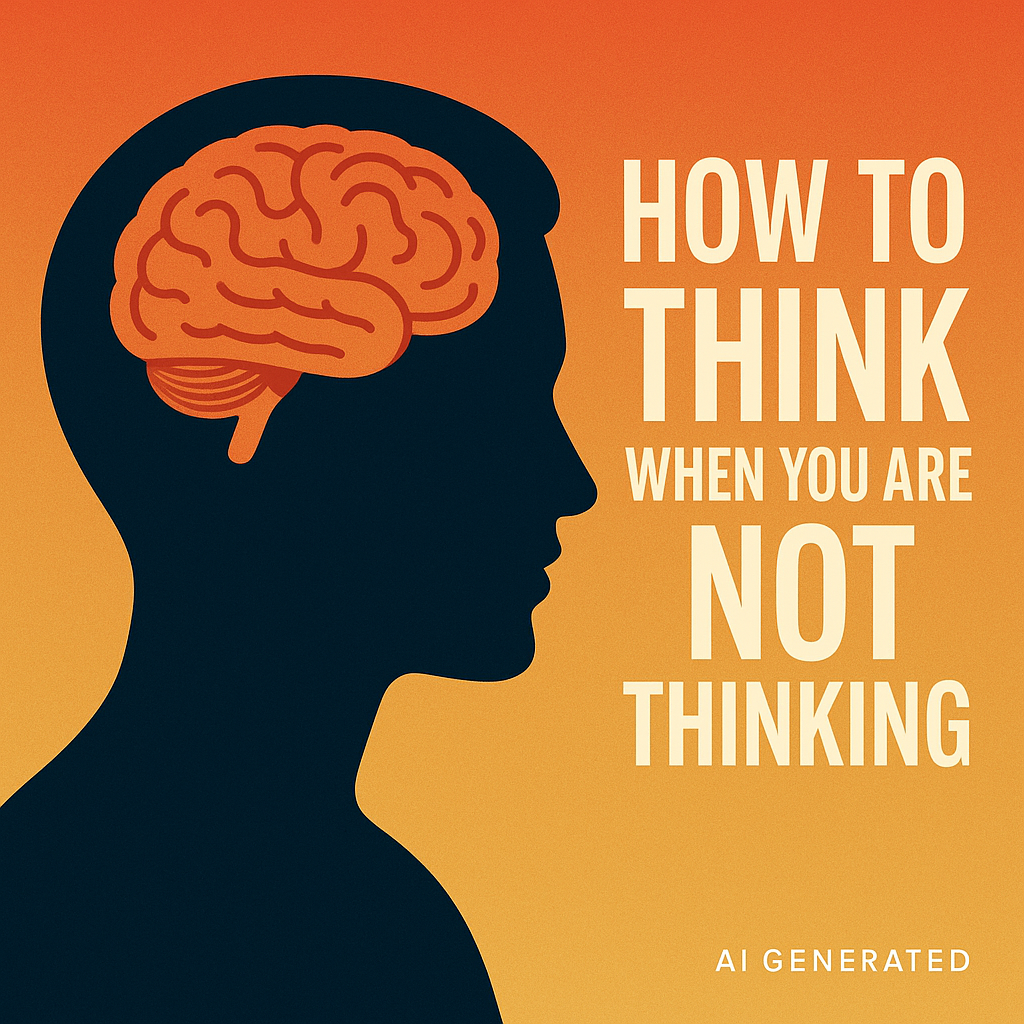
We have been time and again told that think before you act and think a thousand times before taking a decision. But have we ever been told what to think when we are not thinking at all. There are jokes on men sitting idle and their partners inquisitive as to what deep thought they are absorbing. In reality, they are not thinking about anything. I want to shed light on what to think and how to initiate thoughts that can train our subconscious and be a preparatory ground for future decisions and actions.

We grew up believing that thinking is somewhat a deliberate and conscious effort everyone endures to avoid mistakes and make informed decisions. The effort in thinking through and the greatest discoveries man underwent were not as a result of thinking and observing all the time. It came through the long walks, showers, daydreams and sleepless nights we dread are taking away our precious time. It came through the mind when it was technically “not thinking” yet somehow thinking better than ever before. In the contemporary era, it is seen as no less than a sin to take too much time in a task or sit idle in observation and deep thought when we have capital to accumulate and overtime pay we can cash into. The opposite is true. Real thinking often begins when conscious thinking stops.

What Not Thinking Really Means

Not thinking does not equate to blankness, emptiness or passivity. It means allowing our thoughts to not be controlled and allowing flow and openness. It allows the mind to have a softer approach where ideas are allowed to come forward rather than be chased. It is not the opposite of mindfulness but definitely a prerequisite to being mindful. A free and independent thought process is the breeding ground for innovation and ideas and exactly what I would like to communicate through this article.

In this process, the brain is anything but idle. It is silently paving the way to cherished memories and past events. It gives purpose and value to the knowledge and wisdom gathered over time and makes informed and thoughtful decisions to daily questions. This place is the quiet place of the mind where deeper intelligence thrives.

The Brain’s Hidden Thinking: The Default Mode Network

According to neuroscience research, humans after they stop active thinking, activate a powerful circuit called the Default Mode Network DMN. The DMN handles creative intuition, big picture thinking, future planning, memory processing and self-reflection. It is essentially the mind’s “background processor” which continues to operate and function even when the mind shuts off during sleep. This can also be referred to as the subconscious mind and we should strive to train this DMN or subconscious brain.

We should take the example of why smokers continue smoking even though they despise it. It is due to the brainwashing that has occurred from an early age. We have seen in movies that injured soldiers are given a cigarette to calm them down, an adventure is to be undertaken and the lead actor smokes before sailing his ship or the last wish of a dying person is to smoke a cigarette. The brain might dispel this notion but the subconscious mind registers it in the system which bothers the smokers who want to quit. In order to quit smoking, the brainwashing and the subconscious mind must be retrained that the smoke does not make you tough or sophisticated. It is an addiction and no one can break it unless you make the decision to quit and retrain your subconscious into adopting a healthier and more courageous identity. All these are achieved through quiet reflection and switching on the DMN and rewiring all the useless and false pretenses attached to your habits.

The Creative Power of Stepping Away

History is full of thinkers who solved problems by not thinking about them. An example is Newton who discovered and understood gravity by sitting idle beneath a tree where an apple fell on his lap, and one of the greatest discoveries that shaped the future of science for the next century was penned down. The great Edison took “thinking naps,” letting solutions rise from the edges of sleep and trying a thousand times before finally inventing the bulb. Einstein found breakthroughs in science while playing violin.

The examples explained above are referred to as the incubation effect where ideas germinate while the conscious mind is occupied with something very simple or nothing at all. In essence, the incubation phase is the ground for all great discoveries and innovations and is practiced by entrepreneurs and government sponsored incubation centers aimed at assisting and developing startups. The breeding ground for thinkers and reformers of previous millenniums were also these quiet and reflective spaces of mind. Be it Socrates, Aristotle or Buddha, everyone encouraged solitary and deep thinking and the contemporary practices in psychology and meditation, be it mindfulness or yoga, are designed for this purpose. When we stop forcing, we stop fixating. The idea is to allow new associations to form and dissolve old assumptions. This is where insight will come in full swing.

Practices That Help You Think Without Thinking

Among the best practices, walking outside the house helps unlock mental movement. Whether it is a long walk in the park or down your block, the small act opens doors to clear thinking and unwinding old associations and thinking patterns. Simple routine tasks such as folding laundry, cleaning, cooking and driving also unlock and unweave new thinking routines. Meditation or practicing stillness is another methodology where silence reveals thoughts drowned by noise. It does not matter which religious affiliation one is associated with; practicing yoga or concentrating on the center of the heart are among the many ways. Intentional pauses in the daily hustle of work and life can help one reset the thinking process. It takes a few seconds to close the eyes and remove all distractions and the piles of pending tasks. These techniques are a solid way of engaging the deeper layers of the mind.

Listening to the Mind Beneath the Mind

The moment we quiet deliberate thoughts, another kind of intelligence wakes up which we refer to as intuition. Intuition, which appears like magic, is compressed experience speaking in a language logic cannot always access. In our daily lives, we encounter multiple people who did not always take the set path to success in life. Most of their success in business or entrepreneurial ventures came through intuition and appears unreal when one hears how they “just knew it.” Practicing and awakening one’s intuition is an essential part of our lives, and making a conscious effort to understand and sometimes overestimate it, even when it appears destructive, eventually helps in making bigger decisions. Logic and sound knowledge do not always take one far in professional life.

The Art of Allowing

To think without thinking is to allow. Ideas and insight come when we stop forcing them and allow a pathway for free thinking. Initially it appears like wandering through a maze, but slowly one begins to enjoy the ideas. Creativity and art thrive in openness and detest strain. It is an equilibrium between involvement and surrender, intention and freedom. Whenever we listen to celebrities or high performers, we come to the conclusion that the best ideas and choices were often the ones that were not chased.

When Not Thinking Is Superior to Thinking

The conscious mind is sometimes a stumbling block in the way of constructive and free thinking. We often realize that overthinking blurs clarity and rigid logic blocks creativity. Thinking too much creates anxiety loops which eventually distort judgment. Furthermore, mental pressure and stress shut down insight and intuition. In these circumstances, not thinking is more of a strategy that can be harnessed to prevent mental breakdown and illnesses. A deliberate stepping back to let the mind recalibrate allows for developing a healthy mind. The foremost aim of an individual is to analyze the thoughts and cherry pick the problems currently important and those that are of a very distant future.

The Balance Between Effort and Ease

Effective thinking can be compared to breathing where inhaling is focusing, analyzing and engaging, and exhaling is relaxing, releasing and allowing. When we focus too much, our mind becomes rigid whereas when we focus too little, we become unfocused. Both are part and parcel of thinking, and the juggle between them is where clarity thrives.


In conclusion, thinking does not always resemble what we imagine thinking to be. It appears in walking, listening to songs, staring at a wall, sitting idle, folding clothes or just silently sitting. These moments when we are essentially not thinking are the fertile ground for insight. The mind is operating and processing even when we step away and often works best when we get out of its way. The mind’s deepest insights and analyses whisper only when we stop trying to hear them. Whether one has to start a new venture, break an old habit or work on new ones that help achieve a goal, training the subconscious is the most significant step one can take to achieve the aim and realize one’s full potential.


AI War and Future of Startups

The world is witnessing two big wars in the past three years, and they have shaped the course of startups in unimaginable ways. These years of warfare have exponentially accelerated technological innovation in AI war, and the years ahead point to a growing global acceptance of drone based and autonomous warfare. The wars in Gaza and the Ukraine Russia conflict have seen the advent of unprecedented technologies, and the pace at which they are acquired and brought into existence speaks volumes about the ongoing AI war where companies race and compete to bring innovation faster than their competitors.

Drone Infested Technology

During war, soldiers and control room operators get creative. They find new ways to use old equipment and demand new technologies as the conflict becomes heated and prolonged. The situation with drone infested technology being widely used in these wars feels like a thousand snipers in the sky. The buzzing robots feel strangely personal for soldiers and opponents alike.

These drones, developed as a direct response to battlefield needs and soldier observations, point to the fact that the next generation of warfare will not be defined by which side possesses the most advanced technology, but by who can integrate, adapt, and counter it the quickest.

Cheap, flexible, and maneuverable intelligence, surveillance, and reconnaissance (ISR) drones resemble a highly iterative game of cat and mouse. Concealment and cover are imperative in this extremely advanced use of drones. The advancement in electronic warfare suggests that when combined with ISR, the resultant offshoots are cycles of cyber warfare and aggressive information warfare. The final result of such drone technology is a battlefield increasingly dominated by autonomy.

Drone Warfare

For reconnaissance, both Russia and Ukraine have incorporated first person view (FPV) drones into their tactical weaponry to locate enemy tanks and infantry vehicles. FPVs signal these positions to artillery and attack drones to conduct pinpoint strikes, either by dropping a dummy bomb or carrying explosives for a one-way strike mission.

Ukraine’s unmanned aircraft systems (UAS) units use quadrotor drones to drop grenades with precise efficiency into Russian tank hatches. The use of dragon drones, which burn thermite into opponent trenches, has also emerged. Thermite, one of the hottest burning manmade substances, is used to burn the vegetation Russians use for concealment. These drones create fear, and the Russians have adapted by pushing columns of Ukrainian field troops into minefields. Tanks and armored personnel carriers have become trivial traps. Both parties therefore rely on smaller units operating with caution and on foot.

The drone war has also moved to the sea. Ukraine’s use of uncrewed surface vessels (USVs) such as the Magura V5 counters the Russian Black Sea fleet. Small enough to avoid radar detection yet capable of carrying 500 to 700 pounds of explosives, these sea drones can significantly damage Russian ships. A major milestone occurred in May 2025 when two Russian SU 30 jets were reportedly downed over Crimea by sea drones, the world’s first shoot down of a fighter aircraft by a maritime drone.

Unmanned Ground Vehicles (UGVs) and Aerial Drones

The rise of autonomous and self-driving cars over the past decade has opened the way for innovation in military vehicles. Whether electric cars or self-driving taxis in Dubai, autonomous vehicles that transport personnel or goods are a highly convenient and efficient innovation. Ukraine and Russia have expanded their use of UGVs to clear mines and conduct reconnaissance missions. According to the Khartia Brigade, the world witnessed the first documented machine only ground assault in northeastern Kharkiv, supported entirely by unmanned mine laying vehicles and aerial drones.

Aerial drone units are becoming central to battlefield strategy, pushing both sides to expand recruitment and training programs for new UAS units. This shift demands a skill set entirely different from traditional infantry.

Lethal Autonomous Weapon Systems (LAWS)

The use of AI powered LAWS presents novel risks: unanticipated escalation, poor reliability in unfamiliar environments, and erosion of human oversight. This raises alarms not only about military effectiveness but also about the openness of AI research and findings. The issue cannot be resolved by high level policy alone; regulation must be developed alongside ongoing evaluation of AI models and their technical behavior.

A clear, behavior based definition of AI LAWS should be established to shed light on the risks presented by their adoption.

Directed Energy Weapons

Russia has made significant progress in directed energy weapons, giving Moscow a more cost effective method to counter Ukraine’s inexpensive FPV drones. In response, Ukraine has adopted decentralized communication models that use multiple dispersed radio nodes and trivial radios to reduce detectability and make it harder for Russian forces to track and jam signals.

Innovation and maneuverability do not always equate to high end technological development. In some areas, Russian forces have switched to using donkeys and horses to move troops and deliver supplies, countering the UGVs and AI drones used to track them. Necessity truly is the mother of innovation, and the wars in Gaza and Ukraine exemplify this fact.

Information Warfare

Moscow is widely believed to release misinformation and disinformation aimed at deceiving Ukraine and influencing public sentiment. Kyiv uses facial recognition to identify soldiers and children in their targeting efforts. Russian intelligence used deep fake videos to undermine President Zelensky, including a fabricated video of him surrendering in March 2022.

Ukraine has used AI powered facial recognition to identify over a quarter million Russian soldiers and locate 198 missing children abducted by Russia. They also maintain an online database tracking killed Russian soldiers.

Cyber Warfare

Russia has launched cyberattacks targeting Ukrainian oil and gas companies, the central bank, and the Ministry of Defense websites. These attacks disrupted public trust, as well as access to money and fuel. Russia later shifted focus to government institutions, communication networks, power grids, and media systems.

In retaliation, Ukraine formed an IT Army, a volunteer force of thousands of hackers conducting offensive cyber campaigns against Russian financial systems, state services, and media.

AI Enabled Information Processing

Information processing and decision making are evolving rapidly. Both sides use ISR drones to gather vast amounts of data and exploit it for strategic advantage. AI software analyzes satellite imagery, drone footage, open source data, and ground reports to provide commanders with lists of covert targets.

The growing demand for business intelligence reporting attracts data analysts and data scientists and creates room for startups to build tools that handle and interpret this expanding data landscape.

Data Storage and Decision Support Systems (DSS)

AI enabled DSS used by the Israeli Defense Forces (IDF) for targeting Hamas has drastically accelerated data processing. The massive increase in demand for data storage and computing relies on commercial providers and startups to rapidly field new battlefield technology.

Cloud infrastructure remains a major concern. Due to strain on domestic servers, the IDF relied heavily on overseas cloud providers. On Microsoft servers alone, IDF data doubled between March and July 2024, surpassing 13.6 petabytes. This creates enormous opportunities for startups and network providers to support and expand IDF data storage.

High Speed Information Processing

The IDF’s AI DSS system, known as Gospel, aggregates vast intelligence data including texts, photos, satellite imagery, drone footage, and seismic sensors to locate Hamas bases and homes as targets. Previously, human intelligence could identify only 50 targets a year. With DSS, they identify up to 100 targets per day. The speed is unprecedented.

Data analysts, scientists, and insight teams review the information and provide conclusions to the Air Force, Navy, and ground forces through an application known as Pillar of Fire.

Dangers of Overreliance on Technology

The IDF relies heavily on AI to ease operational burdens. But overreliance leads to false positives. The system processes target in just 20 seconds, an impossibly short time for a human to perform ethically grounded analysis.

This creates significant ethical risks in the Israel Palestine conflict, repeatedly highlighted by the United Nations, Human Rights Watch, and global media outlets. Rigorous testing is needed, and startups should step in to ensure human oversight across all AI driven cycles. AI enabled decision making should be led by senior analysts and validated through human intelligence on the ground.

Startups and the Way Forward

A 219-million-dollar fund now supports startups and small firms that can fill gaps in the AI war for Israel. The ecosystem has already provided 50 percent of Israel’s anti drone technology, critical as the IDF faces growing drone threats from Gaza, Lebanon, Yemen, and Iran. The startup world is moving toward finding innovative solutions to ongoing conflicts in Israel and Ukraine.

The AI war can be a game changer for startups by encouraging early engagement, analysis of defense publications, and awareness of current affairs and modern military tactics. AI war needs manoeuvrability, adaption and innovation.

I provide talent solutions and have a network of developers, data scientists, IT support engineers, and analysts who can be crucial in aiding efforts to win the AI war. Being an engineer, I thrive in environments requiring last hour solutions and train AI engineers and support staff to deliver innovations that endure for decades. Whether through a joint venture, a contractual project, or long term solutions based work, I am available to discuss any opportunity companies may have.

A Decade in Montréal and Ten Lessons

I came from a South Asian background and knew little about the city or its culture. My parents wanted me to study engineering and pursue my education abroad. My dream was different. I wanted to explore and enjoy life while studying at McGill University. The name, the history, the beautiful parks, the neighborhoods and the busy downtown drew me in even before my first class. My father had studied at McGill’s Macdonald Campus in West Island and often spoke about his time there. I studied at Dorset Elementary School during the course of his degree.

The lessons explained in this article are intended for international students and for those who travel from different provinces to begin their higher education journey. It is also important to mention that the lessons I discuss can be helpful for immigrants and for anyone who becomes a naturalized citizen anywhere in the world. The insights I share come from deep reflection and experiences shaped by the heart of Quebec, Montreal.

Too large a social circle to manage

As a student of Electrical Engineering at the toughest university in Canada, often known among students as the Harvard of Canada, I did not understand how much of a social circle was healthy or how having a very large group of friends could become detrimental to my goals. I had friends from Frosh week, friends from my high school in Lahore, friends from my classes, and others from student clubs such as the Pakistan Students Association and McGill Indo Pakistan Students. My circle grew even larger with seniors and juniors from South Asia. It felt like there was no end to it. There were also cigarette buddies who gathered outside the libraries for a break.

Slowly and steadily, my grades and academic standing were affected because I was trying to juggle a social life that was too large and scattered. I realized I was spending time with people who were not in my discipline and that I was not keeping pace with the demanding Electrical Engineering curriculum. Over time, the circle grew smaller and more focused as I shifted my attention back to studies and completing the degree. Many of my older friends graduated, some with excellent GPAs, and I was left with a few hardworking individuals who cared only about academics. This close-knit group became instrumental in helping me achieve a high GPA in my last two years and in completing my education in a little more than six years.

Stressing too much about grades and the degree

A McGill alumnus and my mentor from Lebanon once told me that when I get older, I will realize that the stress and anxiety I felt about my studies was not as serious as it seemed at the time. I went into probation during my first semester in Montreal and the stress about my academic standing was overwhelming. I worried constantly about whether I would ever finish my degree. The stress created nightmares that still occur. They feel so real that I wake up panicked, usually dreaming about a course I failed, a mid-term I missed or another semester I have to complete.

What once felt unimaginable now seems minor compared to the challenges of starting a business or finding the right job. The stress students take should never come at the cost of their peace of mind. I recommend future students keep their stress within healthy limits and stay mindful of their well-being.

Expecting different results with the same strategy

It is important to admit that I did little to improve my grades except worry and overthink. I did nothing concrete that would turn things around. I stayed within the same social circles, avoided befriending hardworking students, and kept looking for shortcuts. I chose professors known to be lenient and avoided the effort needed to truly excel.

I learned my lesson the hard way after receiving warnings from the student center. I changed my habits much later in my degree. I recommend that students carefully examine their study strategies and put in consistent effort instead of just aiming to pass. Increase your study hours, practice smart studying, and stay disciplined.

Not learning French during studies

Montreal is at the heart of Quebec and one of the most vibrant cities in Canada. It is one of the most live able and student friendly cities in North America. People arrive with different dreams and expectations. One important reality is that students should learn the French language spoken and written by Quebecois. Outside downtown, French is widely used and is essential for understanding the city and its culture.

I recommend that future international students research their destination well and begin learning the language before moving. Once you learn French, a new world opens up and you can explore the city with far greater confidence and enjoyment.

Not eating healthy or exercising

My diet was often a single Subway sandwich in a day. I did not eat healthy, and I smoked a pack of cigarettes daily. A cigarette and a can of Coke were my breakfast. Managing finances and choosing the right meal were daily struggles. I had been a sporty kid growing up and never imagined myself relying on cigarettes and unhealthy food.

I rarely played sports. The only activity I engaged in was cricket and football at the high school next to the Adam’s Building, mainly for socializing. Physical health was not my goal.

Things changed when my mother came to stay with me during my family’s citizenship process. That period remains the most beautiful and memorable part of my education journey. I ate home cooked meals three times a day and went to the gym regularly. I recommend students learn how to cook, stay active, eat well and join sports clubs. A healthy body opens up an entirely new experience.

Not having a very diversified experience

I spent most of my time with people from South Asia and the Middle East. I wanted to meet others and understand different work ethics and cultures, but I stayed within my comfort zone. With students from more than 160 countries at McGill, I missed the chance to learn from so many backgrounds.

The diversity and inclusion I experienced at McGill could have been even richer if I had joined different student bodies. I advise future students to expand their social circles and learn from people across the world.

Not reaching out for help on time

Another important lesson is to reach out for help early. Whether it involves mental health, academics or finances, delays are harmful. I struggled with basic math courses and only later discovered Prep 101, a well-known academy. I eventually found a tutor and mentor from Lebanon who helped me stay on track. He is a brilliant friend who consistently ranked in the highest percentile and later became a doctor in the United States.

Students should never hesitate to seek financial help, academic support or mental health assistance. Contact teaching assistants, professors, tutors, aid offices and counseling services. It is better to seek help early than to suffer in silence.

Infatuation during studies

Infatuation or love can be troubling during an academic journey. The pressure to keep up with studies and juggling your love life can be troublesome for many.

I advise students not to chase love during their studies. Focus on building yourself. The right person will come later without distraction or pressure. Stay steady and perseverant on the path of education.

Not taking risks

I was fearful and cautious during my time at McGill. I wish I had taken more risks and been more adventurous. I travelled across eight states in the United States but always held back because of financial worries. Students should travel more during breaks, take road trips and explore different countries with friends from various backgrounds. If you do not travel, it is as if you have only read one page of the book of life.

Connecting less with nature and God

Whether one believes in God or not, connecting with nature and the inner self is essential. I believe my fears and anxiety would have been much less if I had strengthened my spiritual side. Meditation, walking in green spaces, watering plants, and quiet reflection help a person feel grounded and closer to inner peace.

Conclusion

These lessons remain with me every day, and I hope they can guide others as well. I try to improve myself with each passing day, reflecting on the purpose of life and the experiences I gained in my decade in Montreal.

Studying abroad and immigration are not easy journeys. I try to ease these paths for others by offering counseling and guidance to students and professionals. I believe in open communication and offer my services after understanding the complete background of those who reach out.

My portfolio website is open to anyone who wishes to connect, share their struggles, or talk about their ambitions.

Institutionalization and the Paradox of Freedom

The years, relentless sculptors, carved his will to the stone,

Till prison’s iron sinews bound his own

Beyond those bars, the air lay strange and frail

He gasped for self in freedom’s gale,

For even liberty can wound the man

Who learned to live within a cell

Author’s Note:

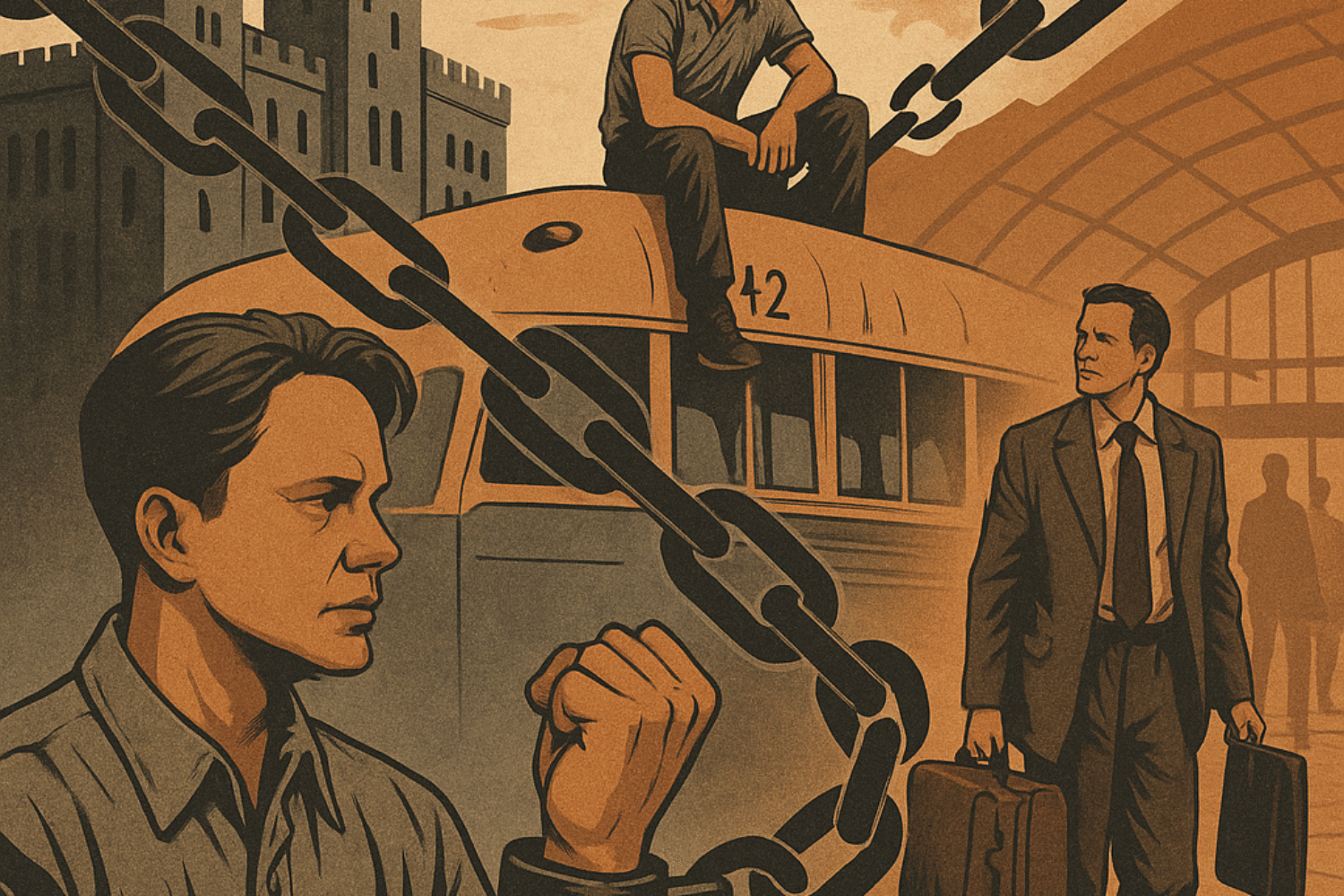
The famous phrase written by Jacques Rousseau in his book Social Contract states that “Man is born free yet everywhere he is in chains.” The human being inherently exercises freedom but is limited through constraints in society, laws, and social obligations. The critically acclaimed Hollywood blockbusters examined here include The Shawshank RedemptionInto the Wild, and The Terminal.

Introduction

Freedom is imagined as the absence of physical restraint, the ability to speak without fear, and the right to choose one’s course of action in the pursuit of happiness. Yet we are bound by the social constructs of race, money, nationality, gender, and by the way institutions operate under governments and those in power. These social norms and constructs often confine individuals without visible walls. Human beings are shaped, limited, and often psychologically chained by the institutions they inhabit, and genuine freedom emerges only when individuals learn to navigate these institutions without surrendering their identity.

The pathway to freedom emerges when one recognizes that being free is a choice rather than an option. The individual who sees the light of freedom even when far from his comfort zone in the most desperate place has discovered the route to ultimate realization, and the films discussed here depict exactly how this is achieved. The time it takes to reach this realization does not matter, and one should make the days count rather than count the days. The protagonists in these films show that the chains that bind us are internal rather than external, and these internal chains are the ones we fear the most.

The Shawshank Redemption: Internalizing the Walls

Andy Dufresne enters Shawshank as an innocent man wrongly accused of killing his wife. Although he was filled with rage after discovering her infidelity, his rational and educated mind prevented him from harming her. As soon as he enters the prison, he understands that he could remain there for life and that the system would never willingly set him free. He befriends long term inmates such as Red and Brooks.

Brooks’ character illustrates that confinement can feel like a place of safety and that release does not necessarily equate to freedom. Brooks had spent nearly half a century in jail and worked as a librarian, helping inmates read and learn. After being released at an old age, he found himself outdated and unable to keep up with a world that had transformed in his absence. His tragic decision to end his life suggests that remaining in prison, where he was acknowledged and respected, might have been a more comforting existence for him. His story shows that decades spent in confinement make one so adaptive and connected to it that no other environment feels familiar.

Andy, however, maintains a free mind from the first month in jail despite taking several years to physically escape. It takes him time to learn the environment, but once he realizes that every inmate is human after all, the fear of prison gradually fades. He is assaulted, ridiculed, punished through solitary confinement, and deprived of food. Yet none of this alters his vision of freedom. With patience and determination, he carves a passage through the prison wall using a small tool and escapes through the sewer system with a liberated soul. His escape produces a sense of euphoria for viewers, comparable to cheering for the boys who survived and avenged their abusive officers in the film Sleepers. The reference to The Count of Monte Cristo is significant, as its themes of wrongful imprisonment and escape mirror the journeys of both stories. Andy ultimately avenges the corrupt warden through his knowledge of financial loopholes, and the film concludes with Andy and Red enjoying the money they secured and sharing a beer like free men on a beach in an unknown country.

Into the Wild: The Illusion of Escaping All Institutions

Where Shawshank depicts the chains imposed by confinement, Into the Wild examines the chains imposed by society. Christopher McCandless is a highly intelligent individual who excels academically and is admitted to Harvard University. His parents, after celebrating his acceptance, begin questioning his career path and financial decisions. He and his sister grew up witnessing constant conflict within their home, and the expectations associated with elite academic culture deepen his disillusionment.

He distances himself from his past life, cutting all ties to his family, banks, and possessions, and embarks on a journey to discover his true self. He travels through Alaska and the scenic landscapes of the United States, savoring each moment of the adventure.

The climax occurs when he finds himself deep in the wilderness, reflecting on his life and the forces he sought to escape. After mistakenly consuming poisonous leaves, he realizes his death is imminent and recalls his entire life in a single flash. The scene is both moving and inspirational. His escape into nature, accompanied by the unforgettable music of Eddie Vedder, seems at first like the ultimate path to self-realization. Yet the final message of the film reveals the truth behind his quest: “Happiness is real when shared.”

His belt, marked with all the places he explored and the work he undertook, symbolizes a journey that could have been more meaningful had he shared it with his family. Self-knowledge carries the potential to enlighten others, and his story reminds us that our greatest fear is not inadequacy but the realization of what we are truly capable of once we understand ourselves.

The Terminal: Bureaucracy as Arbitrary Confinement

While the other two films explore psychological confinement, The Terminal presents a subtler yet equally compelling portrayal of how institutions imprison individuals through impersonal mechanisms. Viktor Navorski becomes trapped in an airport terminal due to geopolitical changes that invalidate his passport. Unlike Andy or Chris, he is confined not by ideology or personal choices but by the rigid and unfeeling machinery of modern bureaucracy.

Most people have spent long hours in an airport terminal, observing the expressions and emotions of travelers. First time travelers and business travelers are easily distinguishable. Viktor, unfamiliar with the language, deals with bureaucracy using his practical intelligence and street wise instincts. He finds peace, love, friendship, and a sense of belonging in a place that initially seems hopeless. Those he encounters view him as awkward and even as a threat to their positions. He helps a friend win the affection of a woman in exchange for food, and he befriends an Indian janitor who fears that Viktor will take his job.

The film also portrays the struggles of immigrants in a realistic and empathetic manner. Bureaucratic officials often view immigrants with suspicion and treat them harshly, causing them to question why they left home at all. Yet, like Viktor, many immigrants find their way and pursue the American dream. The character is inspired by a real life individual who eventually became a naturalized citizen and even returned to work at the airport where he was once stranded. People often revisit the places that challenged them in order to understand their past and find closure.

The Terminal suggests that freedom lies not in escaping institutions but in how one lives within them. Viktor’s ability to maintain his identity despite being in limbo reinforces the thesis that true freedom is a balance between structure and self-definition. Even in a space not designed to be a prison, he displays agency and dignity while acknowledging institutional authority.

Synthesis: The Paradox of Being Free in Chains

Together, these three films provide a unified critique of modern life. Prisons, societies, and bureaucracies shape human identity far more profoundly than physical constraints. They create expectations, fears, and dependencies that limit autonomy even when the body is free. Yet these films also show that institutions are not entirely oppressive. They sometimes provide the structure necessary for survival and meaning, which is an important takeaway.

The paradox is clear. The world offers endless choices, yet people often feel confined. The chains we carry are not always placed upon us; at times we create them ourselves. Andy resists institutionalization. Red struggles to overcome it. Brooks cannot survive without it. McCandless rejects institutions entirely but discovers that absolute freedom can become a prison. Viktor lives within an arbitrary institutional trap yet finds dignity and agency.

These characters demonstrate that freedom is not the absence of institutions but the ability to engage with them without losing oneself. That is the central argument connecting the three films and supporting the thesis. Engagement without alarm is the ultimate means of overcoming institutionalization.

Conclusion

The exploration of institutionalization in The Shawshank RedemptionInto the Wild, and The Terminal reveals that the most powerful chains are not physical but psychological and social. The films argue that individuals must confront the institutions that shape their identity and decide whether to be defined by them. True freedom is neither total escape nor total submission but a deliberate negotiation of the structures that guide human life. Through their struggles, the characters affirm that the world is indeed free yet in chains and that freedom lies in how we navigate those chains rather than in pretending they do not exist. As human beings, we should strive to avoid becoming institutionalized and seek to discover the self. It is our duty to search for the right answers and remain committed to the path of self-discovery, recognizing the signs that lead us toward ultimate realization.

The World Woke Up: Reflections on Woke Culture Across Continents

My First Encounter with Woke Culture

When I first heard the word “woke,” I was in Montreal, surrounded by students passionately debating issues of race, gender, equality, and privilege. Having been a part of the Office of Students with Disability at McGill, I have experienced students being differently abled and unable to identify their gender and inclination towards a specific race or community. They have been bullied at school and labelled with different names including red-headed, sissy, tomboy and black from a very tender age.

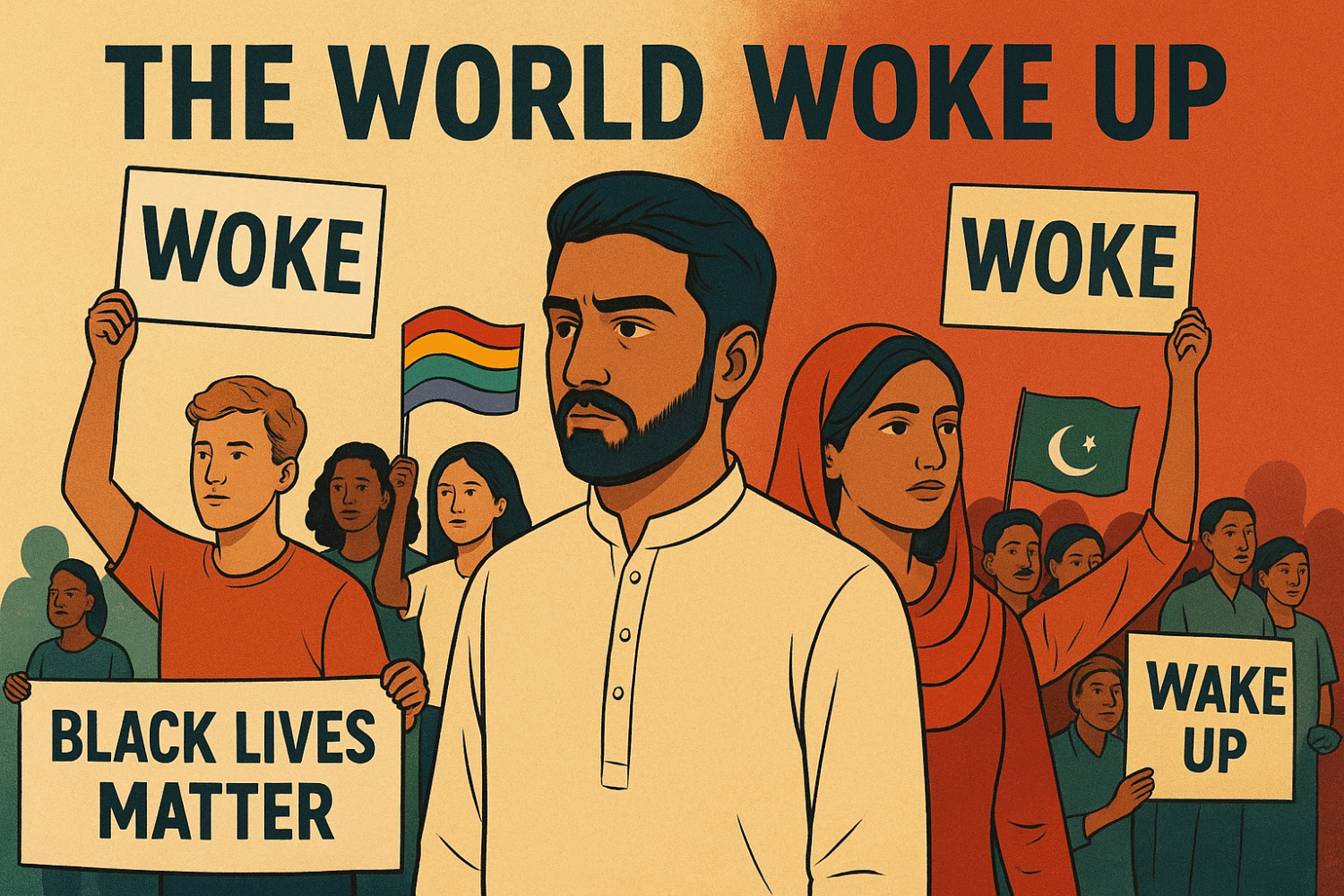
Spending a year in downtown Montreal at a leading engineering consulting firm, I witnessed the pride movement taking its full form and pace and experienced it first-hand along with the hate they receive. The term woke means you are awake to injustice, an ally to the oppressed, and the one who saw. But the more I tried and later returned to South Asia, I realized that wokeness does not look the same everywhere. In western countries it is a moral badge whereas in South Asian countries it is no less than an insult. One cannot help but wonder: what does it truly mean to be awake in an unequal world?

The True Origins of Woke Culture

Woke culture in its original sense was holistic and mesmerizing. The African American struggle against systematic racism that spanned over a century were the pioneers and seeing them see the twilight of their struggle inculcated belief in others to stand against oppression and injustice. Black lives matter, LGBTQ rights, feminism, climate justice and struggle for democracy all are branches of the woke culture.

I admired how the youth in the West cared so deeply about equality and identity and I learnt a great deal about diversity, inclusion and equity studying with people from 160 countries boxed in the eighty-acre campus of McGill. Professors encouraged open discussion about colonial history, anti-Semitism and gender inequality. I witnessed posters on the walls of the campus advocating the rights of the Palestinians and students in the engineering department raising their voice against a professor whose research was used in the making of drones that hit West Bank.

The pride month and the day for indigenous Canadians are also other events I took a part in while working as an engineer in Montreal. There was something deeply humane about all these experiences I had and it taught that people in general want to make the world fairer.

The Shattered Idealism Upon Returning Home

It did not take long for that idealism to turn complicated. As soon as I returned to Pakistan, I realized my emotional attachment tied to the woke culture would be shattered to pieces. Pakistan has struggled for a democratic system since its inception. It has seen various military regimes and democratic parties being toppled by establishment to play the game of thrones.

I witnessed two elections after graduating from Canada and the results amaze me to this day. The election gets rigged in broad daylight, electable candidates are bribed to be with the other party and complete restriction is imposed on political movement. The state which the establishment defines as a “hard state” brings in amendments in the constitution for their benefit and install puppet judges in the high court and supreme court. The judges are either bribed or their families are tortured or their private intimacy videos are threatened to make them public.

There is no law and order where there is only projection of fraudulent and nonexistent government initiatives aimed at attracting the poor. The poster the size of a building is projected along the busy road of the 20 million population of Lahore.

South Asian Parallels in the Struggle for Equality

The situation is no different with India and Bangladesh where inequality and a fair system is longed by the common people. We witnessed in Bangladesh that students protested against the unfair quota system in government departments that allowed certain amount of seats for the people belonging to a specific group of people who opposed Pakistan before and after the partition of East Pakistan in 1971.

Students showed their grit and determination overthrowing the dictatorial government of Hasina Wajid and installing a government compromising of youth. The youth does not believe in stories and experiences of their elders and want to create their own history which the Bengalis did with the ultimate sacrifice of precious lives in the hundreds.

India on the other hand has marginalized and cornered Muslim population where even a petty government job is competed with a thousand Hindus. The Kashmir situation is also in the public eye with it being a United Nations issue since the illegal occupation and accession by Hari Singh in 1948. They face over 900,000 Indian paramilitary forces for decades and nothing has stopped them from exercising their right to self-determination and practicing their religion with freedom.

Their resilience and belief remain unshaken in the wake of oppression that is no less than the genocide in Palestine. The Indian government repeatedly bans the sacrifice of cows and bans the call to prayer of Muslims which reminds us of the atrocities in the Indian subcontinent before the British empire left. The Muslims do not have a majority in any single province and do not raise their voice at platforms that matter. The RSS is an anti-Muslim and racial seniority wing of the BJP party led by the butcher of Gujarat, Narendra Modi. He is a declared terrorist who has killed hundreds of Muslim lives and wins elections based upon his hate towards Muslims and Pakistan.

There is no woke culture that can thrive with Machiavellian leaders in the likes of Modi and the generals ruling Pakistan.

Feminism and the Eastern Struggle for Identity

On the social perspective, Pakistan witnessed a wave of feminism with its “Aurat March” mimicking the second wave of feminism. I am a believer of constructive feminism and support the role of women that played a big part in the creation of Pakistan and preserving the family structure in the East. The right to vote and other areas such as domestic violence in the West were very significant issues to raise voices for, and the world is a better place because of it.

The adoption of feminist concepts in the dynamics of Pakistan are ambiguous and do not carry weight. There is a big difference in the struggle of women in the East as compared to the feminist movement in the West. Women are an instrumental part in the upbringing of children and have played their part in the political sphere in Pakistan as well. We have had a female prime minister two times in history and the current chief minister of Punjab is also a woman. We never faced issues of the right to vote or the right to stand for the president’s office.

The struggle of the women here in the subcontinent is very different from the West and it is high time to not use the woke movement in the same fashion here in the East and stop mimicking the West in every sphere of life. They do not have issues with food, electricity, internet and housing like we do. In Canada, I experienced a welfare state where every affair is taken care of by the government and women are supported if their husband does not turn out to be fair and responsible.

Women here are ridiculed if they are left by their husband and spend the rest of their lives proving they did not do any wrong. To leave a husband or to disobey him and return to your parents’ home is a doomsday for women. I have experienced these issues first hand. If a woman does not get married, she is ridiculed till she is in grave. If a woman has a child and she goes to work to support her kids, she is ridiculed in the office space and life is miserable for her inside and outside of her household. Her children are the ones that suffer the most and they are left to the point of begging on streets.

The Me Too Movement and Its Unintended Consequences

The Me Too movement in India that highlighted the issue of sexual harassment and child molestation is also a sensitive topic that I will try to give my perspective on. The Twitter trend was the top trend because most people, be it a man or woman, have experienced sexual molestation or harassment either in childhood or during later years. They had an anger they wanted to release and saw social media as a platform to speak their hearts out.

The result was that many people started posting made up stories and blaming innocent people. We witnessed many television series in Pakistan that sprung after the Me Too movement. Many celebrities in India came to the limelight explaining their stories and the shameful stories of casting couch were exposed. The result was a lot of blame and hate that spread across.

Celebrities in Pakistan, most famously the case of Ali Zafar and Meesha Shafi, drew a lot of attention where she blamed Ali Zafar for sexual harassment. The court later passed the verdict that Ali Zafar was found not guilty. This shows that blindly following a trend set in the West results in non-existent issues coming in the East instead of focusing on real and prevalent issues in Pakistan. The liberals of Pakistan have done no justice to highlighting where there is room for improvement as they do not leave their drawing rooms and have no ground knowledge.

Hence, it is imperative to stop using imported wokeness and focus on the real issues such as caste, religion and class dominance in South Asia.

The Awakening of Global Conscience in Gaza

The global reaction to Gaza is a beacon of hope for the world. The Muslim countries were busy with their non-existent borrowed wokeness and the western countries being free, independent and conscious exercised their right of free speech and freedom of movement to raise their voice like they did before the invasion of Iraq.

I witnessed and participated in peaceful protest in Montreal that had a roar like an army approaching with heavy artillery. The conscious and honor of Muslims felt lost and unheard in the wake of the holocaust of Palestine. They are oppressed by Machiavellian rulers and puppet governments and like to remain slaves to them. The West, especially students in California and the Ivy League schools, displayed why they are considered the smartest in the world.

The use of brute force could not stop them nor any bribe. They used their education and intelligence to the full and realized the real meaning of education which is enlightenment. The world will be a better place if youth stand for their rights and against oppression and use their education for the pursuit of happiness.

Conclusion: The True Meaning of Being Awake

From my experience across continents, I have learned that to be woke is not simply to follow trends or imported ideas but to understand one’s own realities. True wokeness means being self-aware, standing against oppression, and refusing to remain silent in the face of injustice.

The West must continue to use its freedom with responsibility and the East must find its own authentic way of awakening without losing its soul. When humanity learns to rise together for truth and fairness, only then can we say that the world has truly woken up. The world does not need more wokeness that is loud and disrespectful rather more awareness that is humble, gentle and human. Perhaps the day we stop using “woke” as a label and start using it as an act of empathy will be the day we truly wake up.


Actions Are Judged by Intentions


Introduction: The Heart of Every Action

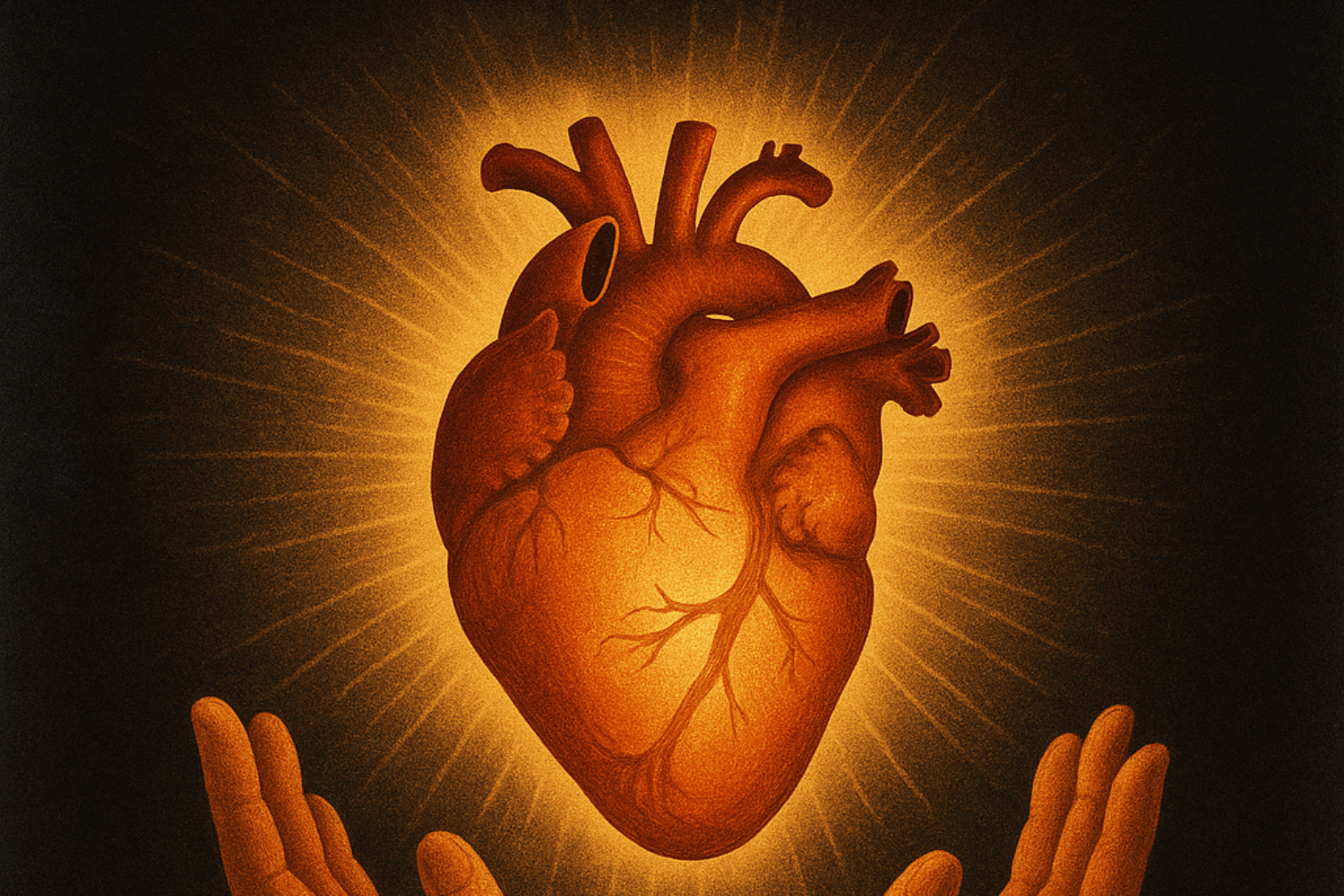
There is a famous saying that your actions speak larger than your words. The real question that remains unanswered is what is the underlying thought before every action. The heart of every action is tied to the intention that precedes it. The small voice from within that dictates our actions is responsible for all the conclusions and results of life. The Holy Prophet Muhammad (Peace be upon him) in a famous Hadith mentioned that: “Actions are judged by intentions.” The meaning and essence of this saying is that all the rewards we reap in this world depend on the instantaneous thought we get just before following that action. The thoughts come from the heart, and the heart of every action is in the intention that precedes it.

A prominent proverb says you sow what you reap. The intention is the pillar stone of our actions upon which the entire building of life stands either rock steady or dissipates like boiling water in ice cold temperature. Our behavior is a result of the actions we take in our daily lives. In cognitive behavioral therapy (CBT), we are taught that thoughts impact emotions and emotions develop actions. This works like a feedback loop in control systems where emotions or feelings create thoughts and thoughts drive actions. A therapist primarily targets negative thoughts and emotions and tries to restructure them into constructive and positive thinking patterns. The session typically occurs biweekly with total therapies lasting two months or less.

I have taken CBT sessions from a well-known clinic in Westmount, Montreal, to help come to terms with recurring and remunerating thoughts about my background from South Asia, to which my Iranian counsellor helped me come to terms with my negative thoughts. The purity of intention and positive thought process before any action results in the best of both worlds and helps one sleep calmly and be mindful of all their deeds.

When Intention Shapes the Meaning of Action

I have been a fortunate person surviving the toughest of situations due to setting my intention straight and clear before my actions. I have survived being kicked out of university and going back to my country in shame and disappointment. I survived months of black depression and solitude due to having a higher purpose of getting education from abroad. As the Messenger (Peace be upon him) dictates: “Seek education even if you have to go to China.” I tried following this saying and although I deviated from the path of learning for a while, I got back on my feet remembering my initial purpose set forth.

A person gets exactly what he made his move of going away from home for. If he went to marry someone, he will marry that person, and if he went for monetary benefits, he will reap financial gains. I went to learn and grow as a person and I got exactly that. All my actions in the way of achieving my aim were stepping stones for the higher aim of post-secondary education. If the end result is a success, the whole journey is a triumph as well.

Intentions in their purest form make the journey feel like an adventure and a path less travelled by. I feel my life is somewhat like the great write-up by Paulo Coelho where every experience and lesson gets one a step closer to the treasure. My story, like Santiago’s, boils down to the truth that if one truly is passionate about something in life, the whole world conspires to help you get to the destination. I found myself lost in the journey just like Santiago, and whenever I felt this was the end, there was either an incident or a person who came by to get myself back on track.

Between Appearance and Authenticity

The virtue of the contemporary era revolves around performance and acts recorded on camera rather than authenticity and pureness of intention. We observe in our daily life how people pretend to act like they are helping the poor and the elderly while in actuality they are just recording it for views and subscribers on social media. People want to show off a good side of themselves but in actuality it is just a stunt and performance-based social work. The actions of such fake people put the good souls in the shadow and all we see and hear are video gamers and gamblers showing a soft side towards the poor when in reality they are nothing but pretending.

People act to be religious as well in order to earn appreciation and recognition, especially here in South Asia. In Pakistan, we encounter in our daily lives people explaining how much of the Quran they read, when they prayed their last prayer, and how many times they have made a pilgrimage to the holy places. The acts done and the intention behind them is to show people how much religious they are and that other people have something to learn from them. On the contrary, the people with good intention are often judged based on their lack of action in religious duties and are put to shame for not doing enough.

The question I ask myself goes by: Who are they to judge intentions and actions? I am then reminded of the fact that God is All-hearing and All-seeing. We are not subject to the judgment and applied reasoning of other humans based on their self-projection.

East and West: Different Paths to the Same Truth

Throughout history, both Eastern and Western traditions have recognized the moral centrality of intention. The Eastern philosophy, especially Islamic tradition, focuses on the spiritual reward of any act. A simple act done in sincerity is accepted in divine eyes, whereas a prayer for display will be returned to the hypocrite instead of reaping its reward.

In Western philosophy, Immanuel Kant’s concept of goodwill reflects on the same underlying principle that good without qualification is the will guided by moral duty, not by self-interest. The Austrian survivor of the Holocaust, Viktor Frankl, wrote that purpose gives meaning even in suffering. The “why” is more important than the “how,” and it beautifully captures the strength of pure intention. The great minds of the twentieth century had their “why” set crystal clear from the beginning, which helped them grind their way to the top with a warrior spirit.

Intentions and Power in Global Affairs

On a global scale, intentions often separate justice from hypocrisy. Many nations claim to act for peace but pursue power. The onset of the twenty-first century has seen global powers pursuing wars fought under the banner of freedom yet fueled by greed and control. Intention reveals truth where policies cannot.

The current affairs in Pakistan and its neighbors also depict the fact that the establishment is fueled with hypocrisy and double games where terrorists are used again and again to have control over the region, yet they state to the public that the War on Terrorism is being fought to drive them out. The essence is that they do it for financial gains and always want the powers within them instead of having democratic processes to follow through.

The global response to Gaza exposes this duality. Students across North America stood in solidarity for humanity while powerful governments chose silence. I witnessed the protests and saw the tears and pain from people of all races and backgrounds. The unanimous voice of these protestors speaks volumes for the common good in people, and they genuinely and intrinsically want good for children and the oppressed.

Even in South Asia, history shows that a leader’s legacy depends not merely on results but on perceived intention. A leader who acts with honesty and conviction may falter in politics but remains eternal in the hearts of people. History forgives mistakes, but it never forgives deceit. The deception found in South Asian countries is unimaginable by Western democratic citizens fighting for increases in salaries and rising housing prices.

Personal Lessons from Everyday Life

There have been moments in my life when my intentions transformed how I saw my actions. My intention to help other citizens helped me in achieving my financial as well as long-term goals. Every job I underwent was driven by the fact that I had to help others if they felt lost or needed guidance. I have worked as a career counsellor for a high-end school in Lahore, where I helped students take their university decisions and guided them with their career choices. I started a business for immigration consultancy where I aided people in making their decision of moving abroad and assisted them with their choice of country.

In my everyday life, I long for a higher purpose and attach myself to people with a shared cause of helping the poor and supporting a political and social cause. My decisions revolve around these ambitions and I genuinely feel a euphoria helping people set up a business or find a job in their dream company.

When Purity Becomes Power

Pure intention is power in its quietest form. The intention of Pakistan’s most popular leader, Imran Khan, was that he did not want the poor to undergo the expensive cancer treatment his mother received and later succumbed to. He built a cancer hospital that provides free treatment for the needy for the past thirty years. He made a party with the slogan of justice and has been fighting a corrupt and decaying system for decades. He is still in jail living in the worst jail conditions, all due to the fact that he genuinely believes in his mission and has the purity of intention.

The movements throughout history, from the civil rights movement in America to the youth-driven revolution in Bangladesh, show that the thing that united people was not privilege or politics but the sincerity of cause. The leaders that are driven by greed fade quickly, whereas those driven by compassion become immortal. A pure intention breathes life into leadership, art, innovation, and activism.

Conclusion: The Heart as the True Judge

History has shown that actions without sincerity collapse under their own weight, while those rooted in honesty endure beyond generations. From the teachings of the Holy Prophet (Peace be upon him) to the reflections of Kant and Frankl, the message remains the same.

In the end, what defines us is not what we achieved in life or how much money we have in our bank account, but the truth of our intentions. The houses and property we built are left for others to enjoy and reap benefits. Intentions form the unseen architecture of our moral selves. The intention to choose between right and wrong is given to us in each passing moment. Our actions dictate what choice we were given and the decision we enacted.

Author’s Note

The inspiration to write on the subject of intentions came from moments of deep personal reflection and the quiet realization that what drives us often matters more than what we achieve. Having lived and studied across continents, I have seen how intentions shape people, policies, and even nations. Whether in Montreal or Lahore, in classrooms or protests, I have witnessed that sincerity of purpose gives life a meaning beyond recognition or reward. This essay is a reflection on the power of intention which define not just our actions but the very essence of who we are.